TL;DRIf your passport is lost or stolen abroad, an emailed scan of the bio page is the single most useful document you can hand the embassy. It takes 60 seconds before you leave and can save days of paperwork at the consulate.
You will probably never need this. That's the point. A lost passport on day three of a two-week trip is the kind of problem that ruins everyone's mood, eats whole days of itinerary, and costs hundreds of dollars in change fees. The 60 seconds it takes to scan your passport bio page and email it to yourself before you leave is the cheapest insurance in travel.
The reason it works is unglamorous: the US State Department lists "proof of US citizenship" as one of the documents you need to walk into an embassy with after a passport theft, and the photocopy of the bio page of the missing passport satisfies that requirement when you don't have your birth certificate on you. A clean readable scan with the MRZ (the machine-readable line of letters and numbers at the bottom) intact gets you through verification fast. Without it, you're recovering documents from home, and that can mean waiting for a parent or friend to scan and email things over a hotel WiFi at three in the morning, their time.
Why this matters more than people think
Three things change the moment your passport is missing.
First, you're not legally in the country. Most countries require visitors to carry a valid passport. The replacement window matters not just for your flight home, it matters for the days in between, where a routine police stop can turn into a long afternoon at the station.
Second, your reporting timer starts immediately. The State Department's online lost-passport form cancels your passport within one business day of submission. That cancellation is what protects you against identity theft, the cancellation is the protective act, not the scan itself. But you can't reissue without the embassy verifying who you are, and that's the part the scan accelerates.
Third, the embassy doesn't operate on tourist hours. US embassies and consulates are generally closed on weekends and US federal holidays, and many overseas posts also close on the local country's holidays. Lose your passport on a Friday night in a country with a Monday national holiday, and you're not getting a replacement until Tuesday at the earliest. Anything that speeds up your Tuesday morning appointment is worth doing now.
How to actually do it
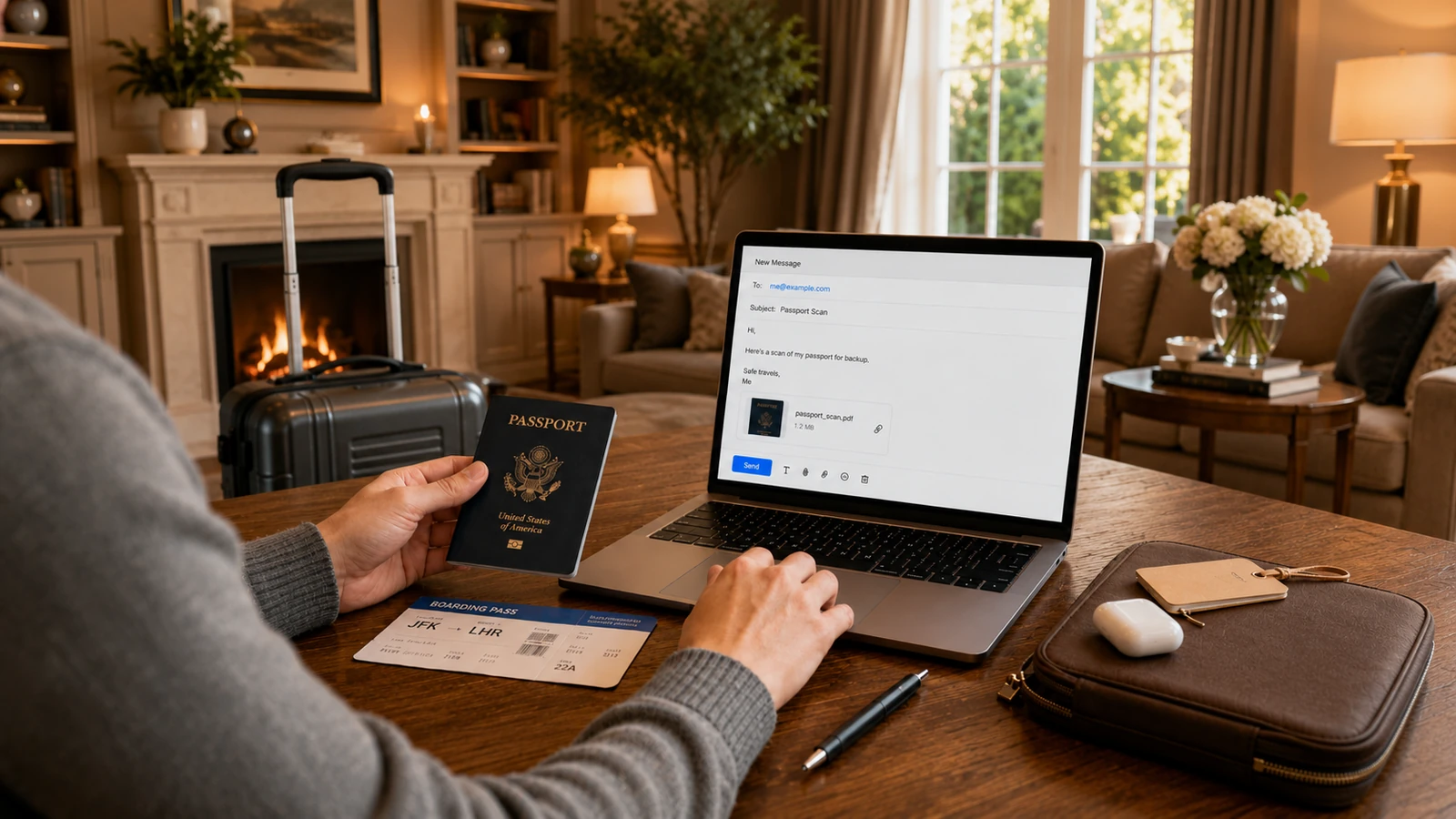
The scan itself takes about a minute. Open the passport flat to the bio page (the one with your photo). Use your phone's scanner · Apple's Notes app, Google Drive's scan function, or Adobe Scan all produce flatter, cleaner output than a regular photo. Check that the MRZ line at the bottom of the page is sharp; if you can't read those letters and numbers on your screen, the consulate's officer can't either.
Save it as a PDF, not a JPG. PDFs render reliably on every embassy intake system; JPGs can get auto-rotated, downsampled, or stripped of metadata by various email clients. Name it something obvious, passport-LASTNAME-FIRSTNAME.pdf, so you can find it under stress.
Then put it in three places:
- Email to yourself, but to a personal address you can log into from any browser without your phone. If your only way to access Gmail is a 2FA code on the phone you're traveling with, and your phone gets stolen at the same time as your passport (it happens, same pickpocket, same minute), you're locked out of the email you need.
- Encrypted password manager. 1Password Secure Notes and Bitwarden both let you attach a file. This is the most robust option because access is biometric and survives a lost phone (you log in on the embassy's computer with your master password).
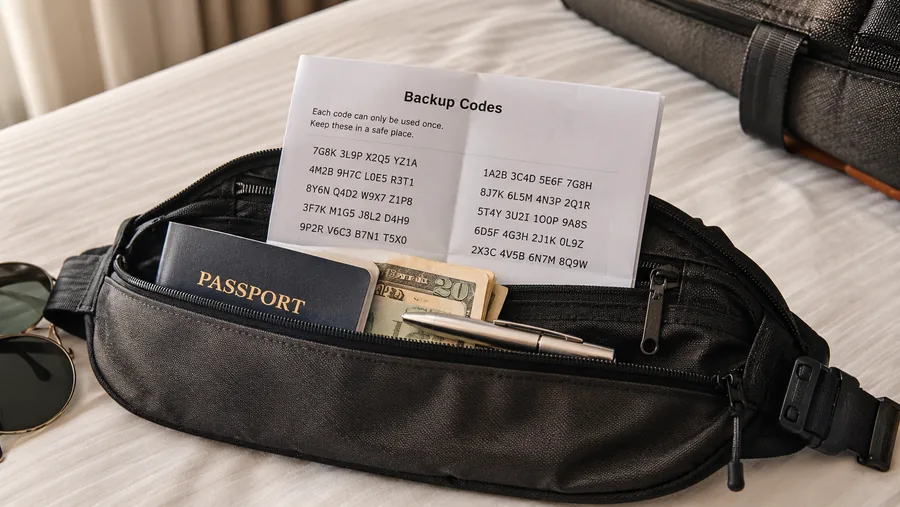
- Paper copy, folded in your checked luggage or a money belt, kept physically separate from the passport itself. Belt-and-suspenders.
Include the visa pages with stamps that show your entry into the current country, some consulates ask for proof of legal entry alongside the replacement application, and the entry stamp page is what satisfies it.
What to do at the consulate
If a US passport goes missing abroad, the immediate steps are: (1) report it lost or stolen via the State Department's online form (this cancels the document), (2) file a police report locally if the passport was stolen (some consulates want the report number; some don't, but the report is free to obtain and useful for travel insurance later), and (3) book an emergency appointment with the nearest US embassy or consulate. Same-day or next-business-day appointments are typical for true emergency travel.
You'll need to bring:
- One 2x2 inch passport photo (most embassies have a photo booth on-site or know the corner shop, but it's easier if you bring two with you on every trip)
- A government-issued photo ID, driver's license works, expired passport works
- Proof of US citizenship, your scan covers this; a birth certificate or naturalization certificate also works
- Travel itinerary showing you need to leave the country soon
- Details of where and when the passport went missing, plus the police report if you have one
- Payment for the replacement fee
For urgent travel, the consulate can issue an "emergency limited-validity passport" valid for up to one year. You can later exchange it for a full 10-year passport at no extra fee using form DS-5504 within 12 months of issuance, as long as the emergency document doesn't carry a special endorsement requiring State Department approval.
Fees match a standard new adult passport, $130 application fee plus a $35 execution fee, with the execution fee sometimes waived overseas because the consular officer executes the application on the spot. Applicants whose passport was lost or stolen abroad are exempt from the file-search fee that would normally apply for a non-emergency replacement. Specific consulates handle billing differently; the embassy website for your country is the right place to confirm.
If you're not a US citizen
The mechanics are similar everywhere, but the document and fee specifics differ.
- UK citizens apply for an Emergency Travel Document at the nearest British embassy or consulate. The fee is GBP 125, processing usually takes around two working days, and you must have held a UK passport issued on or after 1 January 2006 (older passport holders go through a slightly longer process).
- Canadian citizens can apply for a replacement passport or an emergency travel document at a Canadian embassy or consulate. Canada charges a lost/stolen surcharge (currently around CAD 45) on top of the regular passport fee.
- EU citizens whose home country doesn't have a consulate where they're traveling can apply for an Emergency Travel Document at any other EU member state's consulate, under the consular protection rules in EU Directive 2019/997.
Common pitfalls
- Emailing the JPG to a Gmail you can't sign into without your phone. The 2FA code arrives on the device that's missing. Make sure you have either a printout of backup codes (see our 2FA backup codes tip) or an alternative login method.
- Storing the scan only in your phone's camera roll. If the phone is gone, so is the scan. Cloud sync helps only if you can sign into the cloud.
- Low-resolution images. If the MRZ line at the bottom isn't sharp on your screen, it won't be sharp at the consulate either. Re-scan.
- Only the photo page. Include a scan of the visa page with your current country's entry stamp. Some consulates ask for it; all are happy to have it.
- Forgetting the rest of your wallet. While you're at it, scan the front and back of every credit card, your driver's license, your travel insurance card, and any prescription medication labels. Same email, same minute, same value.
Bottom line
One minute now buys you the difference between a chaotic afternoon at an embassy and a routine one. The State Department asks for proof of citizenship; a clean PDF of your passport's bio page is the easiest proof to hand them. Store it in three places that don't all depend on your phone being in your pocket. Add the visa page with your entry stamp. Tell the people you travel with to do the same.
It is the most boring, useful 60 seconds you will spend before a trip.
Sources
- Lost or Stolen Passport Abroad · U.S. State Department
- Report Your Passport Lost or Stolen · U.S. State Department
- How to Replace a Limited-Validity Passport · U.S. State Department
- Passport Fees · U.S. State Department
- Get an Emergency Travel Document · GOV.UK
- Lost, Stolen, Inaccessible, Damaged or Found Passports · Government of Canada