TL;DREat where locals are eating, where the food turns over fast, and where what you're served is steaming hot. The classic 'all street food is risky' fear gets the risk model wrong, turnover and temperature matter more than sit-down vs stall.
The advice you grew up hearing ("boil it, cook it, peel it, or forget it") has quietly been walked back by the people who originally promoted it. The CDC's current Yellow Book chapter on food and water precautions still lists the same rules, but flags them as risk reduction rather than prevention: studies of travelers who follow them carefully have found similar illness rates to travelers who don't. The reason is uncomfortable. The single biggest predictor of traveler's diarrhea isn't whether your meal was peeled or boiled. It's the underlying water and sanitation infrastructure at the destination, which you, the diner, can't see.
So we're left with the visible signals. The 5-customer rule (eat where locals are queuing) works because it's a proxy for the two variables that actually matter: turnover and temperature.
Why turnover is the whole game
The USDA's "danger zone" for perishable food is 40°F to 140°F (4°C to 60°C). Inside that range, bacteria roughly double every 20 minutes. Outside it (colder or hotter) they slow down dramatically. The official rule is that perishable food shouldn't sit at room temperature longer than two hours, dropping to one hour if the air is above 90°F (32°C). Beyond four hours in the zone, time-temperature-controlled food has usually crossed the threshold where reheating no longer makes it safe.
Now think about what that means for two restaurants in the same city.
- The packed stall, pad krapow or al pastor or jian bing cooked to order, served straight off the wok or griddle in front of you. The food's danger-zone exposure is measured in minutes.
- The hotel buffet, same dishes, cooked in the morning, held in a warmer set at the lower end of "safe" because the hotel doesn't want to dry the food out. Three hours in. Looks impeccably clean. The food has been at the edge of the danger zone the entire time you've been seated.
Which one is safer? Researchers who've looked at this find that the contest between street food and restaurants in the same destination is far closer than the "all street food is risky" frame suggests. The temperature and turnover at the stall outperform the appearance of cleanliness at the buffet.
How to read a stall in 10 seconds
Before you order, scan for these specific signals:
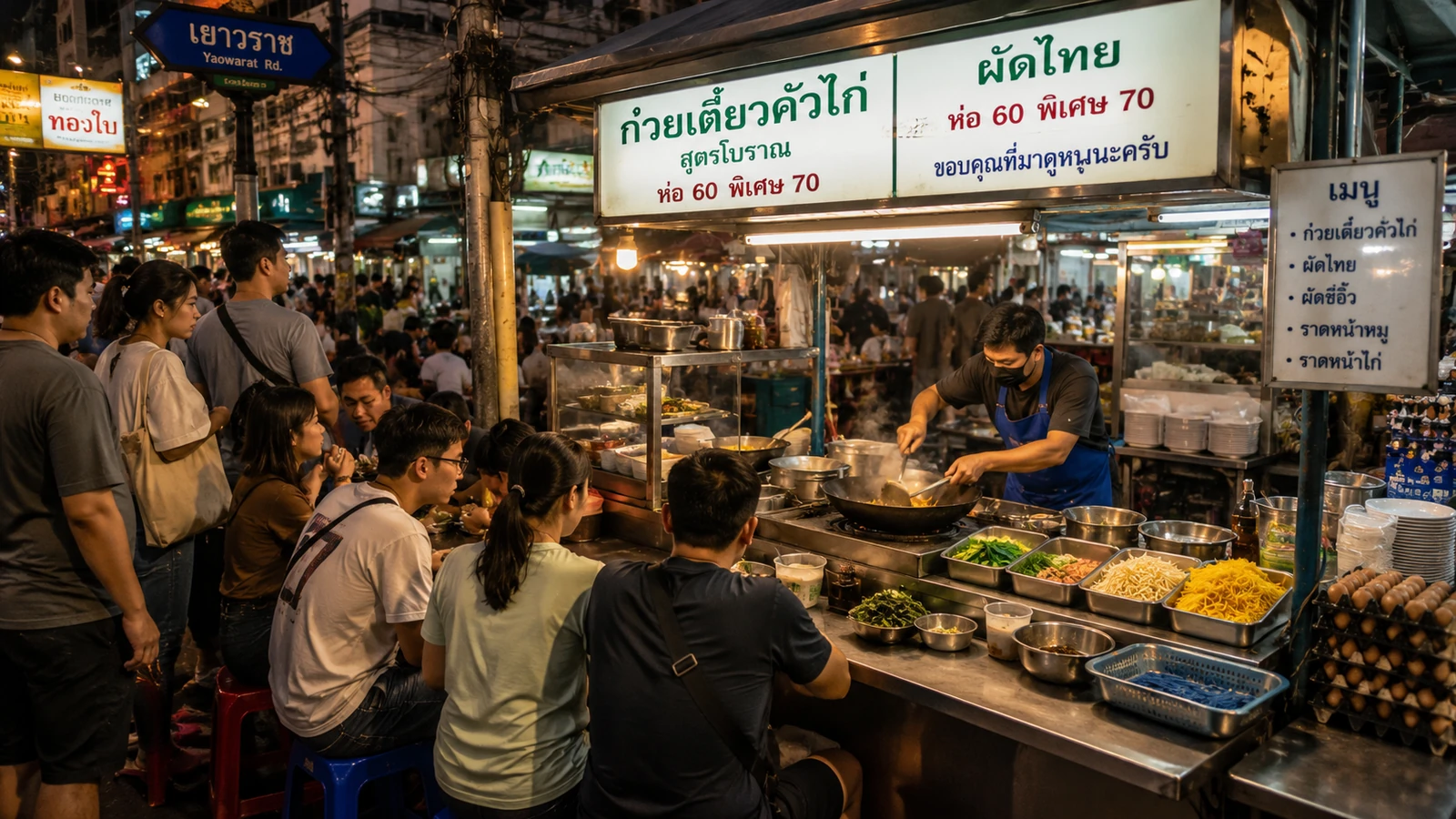
- Real customers, not other tourists. A queue of locals on their lunch break is the strongest single positive signal. They eat here every week. They know.
- Visible cooking happening right now. The wok is hot, the oil is bubbling, the rotisserie is turning, the soup is at a rolling boil. Means freshness measured in minutes.
- The cook isn't handling money and food with the same hand. If there are two people (one cooks, one takes cash) that's a strong sign. WHO food-handler analyses consistently flag cash-handling as one of the top documented contamination vectors at street stalls.
- The oil looks fresh. Light golden oil at a normal foaming level is fine. Dark brown, viscous, foamy oil has been reused well beyond safe limits. Pad thai cooked in that oil tastes like the previous five things cooked in it and irritates more stomachs than the noodles themselves.
- Raw and cooked items are separated. If the same knife and board are used for raw chicken and the salad garnish, walk away. The fix is a separate prep area; the absence of one is a real red flag.
- The stall has been on the same corner for years. A Bangkok regular who's fed thousands of locals without an outbreak is a reputation filter no Yelp star can match.
Regional cues that actually matter
The visible rules above apply everywhere. These are the place-specific ones that travelers most often miss.
Thailand
The most useful icon to look for is tubular ice with a hole through the middle. That's factory-made from filtered water and is generally safe. Cubed or crushed ice from a sack of unknown origin is the gamble. Pad krapow, khao man gai, and any noodle soup served scalding from a constantly-boiling broth pot are the safest defaults.
Mexico
"Agua purificada" signs and visible bottled water in the prep area separate the safer aguas frescas stalls. Al pastor cones with constant carving (turnover so high the meat never really sits) are the textbook safe choice. Be more careful with raw fish ceviche from cart vendors who don't have ice consistently on the catch.
India
Food served visibly steaming hot, with no intermediate cooling step (samosas, freshly tossed pav bhaji, dosas pulled off the tava) has been heat-treated past the danger zone within the last few minutes. Chutneys, raw chopped salads, and pre-cut fruit are the standing hazards (room-temperature, rinsed in tap water, sat in open bowls). The CDC notes traveler's diarrhea incidence in South Asia among the highest globally.
Vietnam
Pho and bun stalls where the broth is at a rolling boil and the noodles are dropped in fresh per bowl are the standard safe choice. The herb plate is the variable, those mint, basil, and bean sprouts have been rinsed in tap water. Travelers who skip the herbs in Hanoi and load up on them in Saigon get the same dish at different risk levels.
What the 5-customer rule doesn't fix
Even at the most packed stall, four categories deserve a pause in higher-risk destinations:
- Ice that isn't visibly factory-made. Tubular = generally safe, cubed from a bag = check, "ice in the freezer behind the counter" = depends on the source water.
- Raw water rinses on herbs and salads. No amount of stall turnover changes what they were washed in.
- Sauces and dips left out at room temperature. Common dipping bowls, fish sauce caddies, chutney trays. Often fine, but they're sitting in the danger zone.
- Pre-peeled fruit on display. Watermelon, papaya, mango, peeled by the vendor with the same knife used elsewhere, sitting open. Whole fruit you peel yourself is the safer move.
That's not "don't eat these." It's "if your stomach has been touchy this trip, those four are the ones to skip first."
Common misconceptions
- "Stick to your hotel restaurant, it's safer." Often the opposite, especially with buffets. Slow turnover + holding warmers = more danger-zone time than a stall where everything is cooked to order.
- "Just eat at chains you recognize." The chain isn't running its own water supply. McDonald's in Mumbai gets the same municipal water as the dosa cart outside.
- "Locals never get sick because they're used to it." They do get sick, they just don't report it to travel medicine surveillance. The acclimation effect is real for some pathogens (the gut microbiome adapts), nonexistent for others (Salmonella doesn't care if you grew up in Bangkok).
- "If it's spicy enough, the bacteria die." They don't. Capsaicin slows some bacterial growth in vitro but not in real-world food at real-world concentrations. The reason spicy food correlates with lower TD risk is that it's usually served piping hot, which kills bacteria. The temperature is doing the work; the chili just disguises it.
Bottom line
The 5-customer rule isn't about counting bodies, it's a fast read on the two variables that actually predict food safety: how recently this dish was cooked, and how hot it was served. Pair the queue check with the cooked-to-order, served-steaming, factory-ice heuristic and you have a working filter that beats the "all street food is risky" instinct most travelers arrive with.
You will still get sick occasionally. Even careful eaters have a 30 to 70 percent traveler's diarrhea rate over two weeks in high-incidence destinations, per the CDC. But you will eat far better, far cheaper, and far closer to what the destination actually tastes like.
Sources
- Travelers' Diarrhea · CDC Yellow Book
- Food and Water Precautions for Travelers · CDC Yellow Book
- Danger Zone (40°F–140°F) · USDA Food Safety and Inspection Service
- Street Vended Food in Developing World: Hazard Analyses · PMC review
- Incidence and risk factors for travellers' diarrhoea · Journal of Travel Medicine